Why Handmade Soap Uses a Blend of Oils: A Simple Guide
-
Posted by
Allison Savino
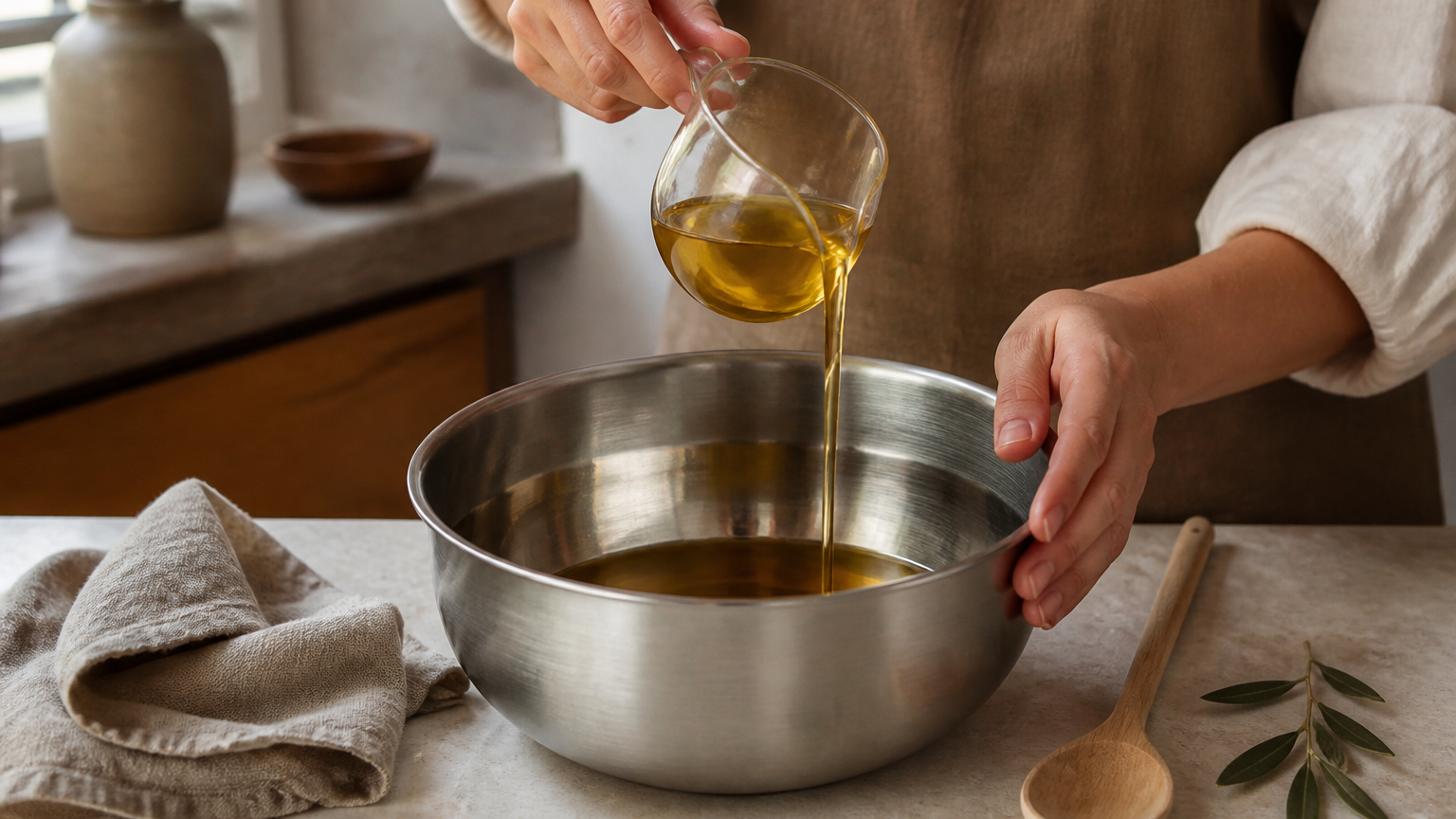
A handmade soap label may list several plant oils, even when the finished product is one beautifully simple bar. That is not unnecessary complexity. Each oil brings its own fatty-acid profile to the recipe, and soapmakers combine those profiles to shape firmness, lather, texture, and the overall washing experience.
Think of the formula as a small team rather than a solo act. One oil may help build a firm, long-lasting bar. Another may support generous bubbles. A third may contribute to a creamier feel. The art is not choosing the single “best” oil; it is deciding which oils work well together and measuring them with precision.
Why Do Handmade Soap Recipes Use Multiple Oils?
Plant oils are made from different combinations of fatty acids. During cold-process soapmaking, those fatty acids react with an alkali solution to form soap. Because each oil has a distinctive balance, no two oils behave exactly the same way in a recipe.
A single-oil soap is possible, but it will naturally emphasize the qualities of that one material. A blend lets a maker build a more rounded bar by balancing structure, lather, and feel. It also creates room to fine-tune the recipe for its intended use, whether the goal is a sturdy everyday shower bar, a creamy handwashing bar, or a playful scented bar for the guest bath.
For a simple explanation of the reaction itself, Plumera’s guide to lye in handmade soap walks through the role of sodium hydroxide and how oils become a finished cleansing bar.
Fatty Acids Are the Building Blocks Behind the Blend
Soapmakers often think beyond the oil names and look at the fatty acids inside them. Palmitic and stearic acids are associated with firmness and a denser, creamier lather. Lauric and myristic acids can support cleansing action and bigger bubbles. Oleic and linoleic acids influence the softer, conditioning side of a formula.
Those categories are useful, but they are not isolated switches. An oil contains a mix of fatty acids, and the complete recipe matters more than one number. The finished bar also reflects water amount, batch temperature, additives, scent materials, mold design, and resting time.
Hardness is about balance, not toughness
A bar needs enough structure to unmold cleanly, hold its shape, and last well when allowed to dry between uses. Oils and butters with more saturated fatty acids can support that structure. A thoughtful recipe balances them with other oils so the bar is firm without making the experience feel one-dimensional.
Lather can be bubbly, creamy, or both
Some oil profiles are known for quick, airy bubbles, while others contribute a tighter, lotion-like lather. Many soapmakers aim for a blend of the two. The result is not always dramatic foam—and it does not need to be. Water hardness, washing technique, and how wet the bar becomes can also change what you see at the sink.
What Different Plant Oils Contribute
There is no universal formula, but a few broad roles help explain why an ingredient list includes several oils. Olive oil is often valued for the gentle, creamy character it can bring to a recipe. Coconut oil can support firmness and lively bubbles when used in a balanced amount. Castor oil is commonly included in smaller portions to help stabilize lather. Butters such as cocoa or shea can add structure and richness to the formula.
Liquid oils such as sunflower, rice bran, sweet almond, or apricot kernel oil can contribute their own balance of oleic and linoleic acids. A maker may choose among them based on the desired bar, ingredient availability, batch consistency, and the way the complete recipe performs over time.
Plumera shares plant-forward ingredient information for shoppers who enjoy looking beyond the front label. Because formulas vary by product, always use the individual product page or package as the source for the exact ingredients in a particular bar.
More Ingredients Do Not Automatically Mean a Better Bar
A long oil list can sound impressive, but the number of oils is not a quality score. A focused three-oil formula can be beautifully considered. A recipe with eight oils can also work well—or become needlessly complicated. What matters is whether each ingredient has a clear role and whether the proportions create the intended result.
This is where small-batch craft becomes quietly technical. Soapmakers calculate the alkali amount for the exact oil blend, because every oil has its own saponification value. Swapping one oil for another is not like changing a garnish. The formula must be recalculated and evaluated as a new balance.
Precision matters at every batch size
Reliable soapmaking uses weight rather than kitchen-style volume estimates. Oils, water, and alkali are measured with an accurate scale, and the maker follows controlled procedures. The charm of handmade soap may be visible in the swirls and hand-cut edges, but consistency begins with numbers.
Resting time has a separate job
After a cold-process loaf is cut, the bars rest in a ventilated space while water gradually leaves the soap. This helps the bars become firmer and last better in everyday use. A smart oil blend creates the foundation; the resting stage gives the finished bars time to settle into it.
How to Read an Oil Blend as a Shopper
You do not need to decode every fatty acid to choose a handmade bar. Start with the full ingredient list, then read the product description for scent, texture, and practical use details. Look for straightforward language rather than a grand promise built around one fashionable oil.
It is also helpful to remember that ingredients are generally listed in descending order by weight before the soapmaking reaction, although label formats can vary. The first few oils often make up much of the formula, while an oil near the end may still have a useful supporting role.
Once the bar is home, the simplest test is the routine itself. Notice the lather style you enjoy, the scents you reach for, and how the bar holds up when kept on a draining dish. Personal preference is useful information, even if you never memorize the difference between palmitic and oleic acid.
Thoughtful Formulation, Simply Enjoyed
A blend of oils is one reason handmade soap can feel both simple and carefully engineered. The finished bar does not ask you to see the calculations. It simply brings together plant oils, measured technique, time, and a scent that makes an ordinary wash feel more intentional.
Explore Plumera’s small-batch handmade bar soaps to find a blend, scent, and style that suit your routine. Keep your favorite dry between uses, enjoy the lather it was designed to create, and let Beauty Through Simplicity take it from there.